Introduction to Bamboo Charcoal Briquettes
Bamboo charcoal briquettes have gained popularity as a sustainable and eco-friendly alternative to traditional charcoal. Known for their high calorific value, low ash content, and minimal environmental impact, these briquettes are used for both domestic and industrial purposes. The process of making bamboo charcoal briquettes involves several stages, each crucial to achieving the desired quality and efficiency. This article delves into the step-by-step process of producing bamboo charcoal briquettes.
Harvesting and Preparing Bamboo
The first step in manufacturing bamboo charcoal briquettes is the selection and harvesting of bamboo. Bamboo is chosen for its fast growth rate and renewable nature. Once harvested, the bamboo is cut into smaller, manageable sections. These sections are then dried to reduce moisture content, which is vital for efficient carbonization. Proper drying can be achieved through natural sun exposure or using specialized drying machines, ensuring the bamboo has a moisture content of less than 15%.
Carbonization Process
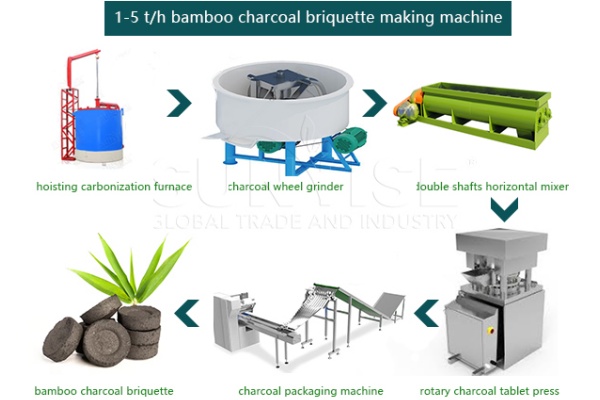
After drying, the bamboo undergoes carbonization, a process of converting raw bamboo into charcoal. This is done by heating the bamboo in a carbonization furnace at temperatures ranging from 400 to 800 degrees Celsius in an oxygen-free environment. This pyrolysis process breaks down the bamboo’s organic components, leaving behind carbon-rich charcoal. The carbonization phase is critical as it determines the quality and combustibility of the final briquettes. It typically takes several hours, depending on the scale of production and the equipment used.
Crushing and Mixing
Once carbonization is complete, the charcoal is left to cool before being crushed into fine powder. This step is essential for ensuring uniformity in the briquettes. The powdered charcoal is then mixed with a binding agent, usually a natural substance like starch or molasses, to help the particles adhere together. The proportion of binder to charcoal powder varies, but it is typically around 5-10% of the total mixture. This mixture is thoroughly combined to achieve a consistent paste-like substance.
Briquetting and Drying
With the mixture ready, the next step is briquetting, where the charcoal paste is shaped into uniform briquettes. This is done using a briquette press machine, which compresses the mixture into desired shapes and sizes under high pressure. After forming, the briquettes are laid out to dry, removing any excess moisture introduced by the binder. Drying can be carried out naturally in the sun or using drying equipment to speed up the process. Ensuring the briquettes are completely dry is crucial for optimal burning performance.
Environmental and Economic Benefits
Producing bamboo charcoal briquettes offers notable environmental and economic advantages. Bamboo is a rapidly renewable resource, making it an excellent sustainable material. The briquettes produce less smoke and ash compared to traditional charcoal, reducing air pollution. Economically, bamboo charcoal briquette production provides opportunities for local employment and can be a lucrative venture due to the growing demand for eco-friendly fuel sources. If you want to know bamboo charcoal briquette price, please contact us.
Conclusion: Embracing Sustainable Energy Solutions
The process of making bamboo charcoal briquettes underscores the shift towards sustainable energy solutions. By transforming a renewable resource into an efficient and clean-burning fuel, bamboo charcoal briquettes contribute to reducing reliance on fossil fuels and deforestation. As awareness of environmental sustainability grows, bamboo charcoal briquettes are poised to play a significant role in meeting global energy needs in an eco-friendly manner. Visiting: https://www.char-molder.com/product/bamboo-charcoal-briquette-plant/
Leave a Reply