Introduction to Rice Husk Charcoal Briquettes
Rice husk, a byproduct of rice processing, presents a sustainable opportunity for energy production. By converting rice husk into charcoal briquettes, we can create an eco-friendly fuel alternative that reduces waste and provides a reliable source of energy. The process of producing rice husk charcoal briquettes involves several stages, each contributing to transforming raw agricultural waste into a valuable resource. This passage explores the detailed process of producing rice husk charcoal briquettes, highlighting its significance in promoting sustainable energy practices.
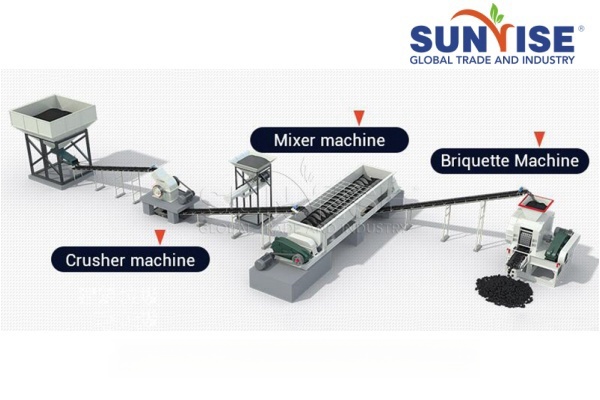
Collection and Preparation of Rice Husk
Harvesting and Collection
The journey begins with the collection of rice husk, which is the outer shell of rice grains removed during the milling process. Typically, rice mills generate substantial quantities of husk, making it readily available for briquette production. Ensuring a consistent supply is crucial, so partnerships with local rice mills are often established to secure the necessary raw materials.
Drying and Storage
Before processing, the rice husk must be thoroughly dried to reduce its moisture content. High moisture levels can hinder combustion efficiency and the binding process. Sun drying is a common method, where the husk is spread in thin layers under the sun. Alternatively, mechanical dryers can be used for quicker, controlled drying. Once dry, the husk is stored in a moisture-free environment to preserve its quality until further processing.
Carbonization Process
Pyrolysis of Rice Husk
The core transformation involves carbonizing the rice husk through a process called pyrolysis. This involves heating the husk in the absence of oxygen, which decomposes it into charcoal while releasing volatile gases. Specialized kilns or retorts are used for this purpose, maintaining temperatures between 300°C and 500°C. The process typically takes several hours, resulting in a charred material that retains a high carbon content.
Collection of Charcoal
After carbonization, the resultant charcoal is collected and allowed to cool. The carbonized husk, now lightweight and brittle, is ideal for further processing into briquettes. The charcoal’s high carbon content and porous structure make it an efficient fuel source with excellent combustion properties.
Briquette Formation
Grinding and Mixing
The cooled charcoal is ground into a fine powder to facilitate binding. This powder is then mixed with a binding agent, such as starch or molasses, which helps agglomerate the particles into a cohesive mass. The choice of binder can affect the briquette’s strength and combustion characteristics, so it is selected carefully based on the desired properties of the final product.
Molding and Compaction
The mixture is fed into a briquetting machine that compresses it into uniform shapes, typically cylindrical or rectangular. The machine applies significant pressure to form dense briquettes, ensuring they hold their shape during handling and burning. Compaction also improves the energy density of the briquettes, making them a more efficient fuel source.
Drying and Packaging
Final Drying
The freshly formed briquettes contain residual moisture, which must be removed to enhance their storage stability and combustion efficiency. They are dried in a controlled environment, either through sun drying or mechanical dryers, until the moisture content reaches an optimal level.
Packaging and Distribution
Once dried, the briquettes are packaged for distribution. Packaging is done in a way that protects the briquettes from moisture and physical damage during transportation. The final product is then ready for distribution to various markets, where it serves as an environmentally friendly alternative to traditional charcoal or fossil fuels.
Conclusion: Sustainability and Energy Efficiency
The production of rice husk charcoal briquettes exemplifies an innovative approach to waste management and renewable energy. By transforming agricultural byproducts into valuable fuel, this process not only minimizes environmental waste but also contributes to reducing the reliance on non-renewable resources. As demand for sustainable energy solutions grows, rice husk charcoal briquettes offer a promising avenue for cleaner, more efficient energy consumption worldwide. Visiting: https://www.char-molder.com/2024/05/11/small-scale-rice-husk-charcoal-briquette-making-machine-in-tanzania/
Leave a Reply