Introduction to Coconut Shell Charcoal Briquettes
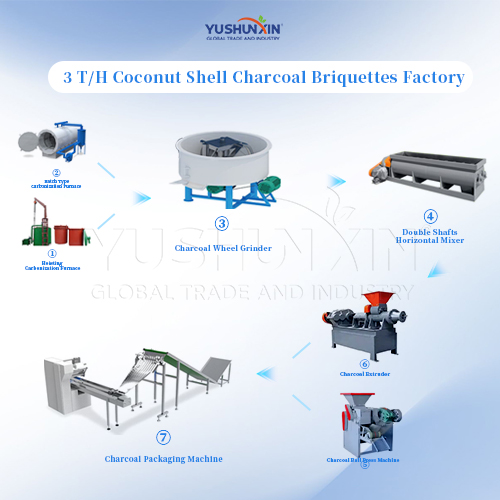
Coconut shell charcoal briquettes are a sustainable and eco-friendly alternative to traditional charcoal, offering a cleaner and more efficient fuel source. The process of converting coconut shells into charcoal briquettes involves several stages, each requiring specific machinery and expertise. Producing 3 tons per hour (t/h) of coconut shell charcoal briquettes involves a series of steps that transform raw coconut shells into compact, high-energy briquettes suitable for various applications, including cooking and heating.
Collection and Preparation of Coconut Shells
The first step in the production of coconut shell charcoal briquettes is the collection and preparation of coconut shells. Once collected, the shells are thoroughly cleaned to remove any residual husk, dirt, or impurities. This cleaning process is critical as it ensures that the final product is pure and burns efficiently. After cleaning, the shells are sun-dried or mechanically dried to reduce their moisture content, making them suitable for the carbonization process.
Carbonization Process
Carbonization is a crucial step in transforming coconut shells into charcoal. This process involves heating the coconut shells in an oxygen-free environment to convert them into charcoal. Specialized carbonization furnaces or kilns are used for this purpose. The shells are subjected to high temperatures, typically ranging from 400 to 700 degrees Celsius, which causes them to decompose and transform into charcoal. This step not only drives off volatile compounds but also enhances the energy content of the charcoal.
Crushing and Grinding
Once the coconut shells have been carbonized, the resulting charcoal is crushed and ground into a fine powder. This step is essential to ensure uniformity and consistency in the final briquettes. Crushing and grinding machines equipped with durable blades and rollers are used to pulverize the charcoal into a fine, homogenous powder. The finer the powder, the better the quality and combustion efficiency of the briquettes.
Mixing and Binding
To form briquettes, the charcoal powder needs to be mixed with a binding agent, which helps in holding the particles together. Commonly used binding agents include starch, molasses, or other organic materials. The mixture is thoroughly blended to ensure even distribution of the binder throughout the charcoal powder. This blend is crucial for the structural integrity and durability of the briquettes.
Briquetting Process
The briquetting process involves compressing the mixed charcoal powder into uniform shapes and sizes using a briquette press machine. This machine applies high pressure to mold the charcoal mixture into solid, compact briquettes. Various briquette shapes can be produced, depending on the mold used, such as pillow, cube, or hexagonal shapes. The briquetting process is vital for ensuring the briquettes are dense, burn steadily, and produce minimal ash.
Drying and Packaging
After the briquetting process, the charcoal briquettes are dried to remove any residual moisture. This step can be achieved through natural sun drying or by using industrial drying machines. Proper drying enhances the burning characteristics of the briquettes. Once dried, the briquettes are packaged in suitable materials, ready for distribution and sale.
Conclusion
Producing 3 t/h of coconut shell charcoal briquettes is a complex process that requires careful control and management of several stages. From the initial collection of coconut shells to the final packaging of briquettes, each step is critical to ensuring a high-quality, eco-friendly fuel product. The process not only provides a sustainable energy source but also contributes to waste reduction by utilizing coconut shells, which are often discarded as agricultural waste. As demand for clean and efficient fuel sources grows, the production of coconut shell charcoal briquettes presents a promising solution for both energy needs and environmental sustainability.
Leave a Reply