Bamboo, often referred to as “green gold,” is a versatile and rapidly renewable resource with a myriad of applications. One of its lesser-known uses is in the production of charcoal briquettes. As the world shifts towards more sustainable energy practices, bamboo charcoal briquettes emerge as an eco-friendly alternative to traditional charcoal fuels. This guide delves into the process of using bamboo to produce charcoal briquettes, highlighting the steps and benefits of this sustainable practice.
Understanding the Benefits of Bamboo Charcoal
Why Choose Bamboo?
Bamboo is one of the fastest-growing plants on Earth, with some species growing up to three feet in a day. Its rapid growth rate makes it an ideal renewable resource, reducing the pressure on forests and providing a sustainable supply for charcoal production. Bamboo’s high lignin content also contributes to a superior burn quality, making it an excellent material for charcoal briquettes.
Environmental Advantages
Using bamboo for charcoal production helps mitigate deforestation and land degradation. Additionally, the conversion process for bamboo to charcoal captures carbon, which can be sequestered in the soil when used as biochar, thus contributing to climate change mitigation.
Preparing Bamboo for Charcoal Production
Harvesting and Drying
The first step involves harvesting mature bamboo culms, which are then cut into smaller sections for easier handling. These sections need to be thoroughly dried to reduce moisture content. Proper drying, often done in the sun, is crucial as it ensures a more efficient carbonization process and higher-quality charcoal.
Carbonization Process
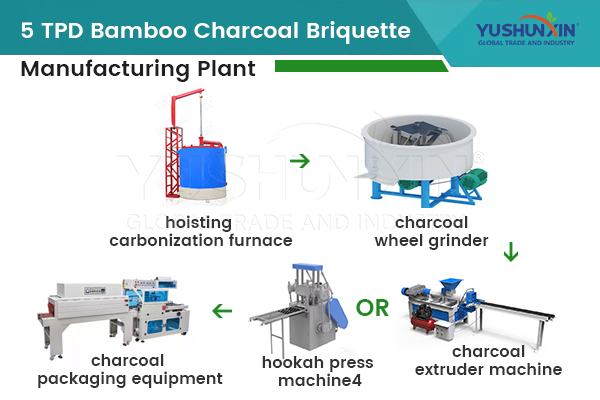
Carbonization is the process of converting bamboo into charcoal through controlled heating in the absence of oxygen. This can be done using traditional earthen kilns, metal kilns, or more advanced retort systems. The process typically takes several hours, during which the bamboo is transformed into charcoal by pyrolysis, breaking down the organic material into carbon-rich products.
Producing Bamboo Charcoal Briquettes
Crushing and Mixing
Once carbonized, the bamboo charcoal is crushed into fine powder. This powder is then mixed with a binder, such as starch or molasses, to ensure the particles adhere together during briquette formation. The ratio of binder to charcoal powder is crucial for the structural integrity of the briquettes.
Briquette Formation
The mixture is fed into a briquette press, which compresses the material into uniform shapes, such as cylinders or cubes. The pressure and heat from the forming process activate the binder, creating a dense and durable briquette.
Drying and Storage
After forming, the briquettes are dried again to evaporate any remaining moisture, enhancing their combustion efficiency. Once dried, they are ready for packaging and storage, awaiting distribution or use.
Quality Assurance and Maintenance
Ensuring Product Quality
Regular quality checks during production ensure the briquettes meet specified standards for size, density, and burn time. Adjustments in the production process may be necessary depending on findings from these checks.
Equipment Maintenance
Maintaining the equipment used in the production process is vital for consistent quality and operational efficiency. Regular cleaning and inspections can prevent breakdowns and extend the lifespan of the machinery.
Conclusion: The Future of Bamboo Charcoal Briquettes
Bamboo charcoal briquettes represent a sustainable step forward in renewable energy. By leveraging bamboo’s rapid growth and superior burning properties, these briquettes provide an environmentally friendly fuel source that reduces reliance on traditional charcoal. As awareness grows, bamboo charcoal briquettes are poised to play an integral role in sustainable energy solutions worldwide, paving the way for greener and cleaner alternatives. Visiting: https://www.char-molder.com/product/bamboo-charcoal-briquette-plant/
Leave a Reply