Overview of a 1 Ton/Hour Briquette Line
A 1 ton/hour charcoal briquette plant is designed for steady, continuous output with consistent quality suitable for BBQ, shisha/hookah, or industrial fuel markets. At this capacity, the key to success is not only choosing a strong briquette press, but also balancing every upstream and downstream step—crushing, mixing, forming, drying, cooling, and packing—so the press never starves for material and finished briquettes don’t bottleneck at drying or packaging. In practice, the full plant is a coordinated system of machines, conveyors, and controls rather than a single “big” machine.
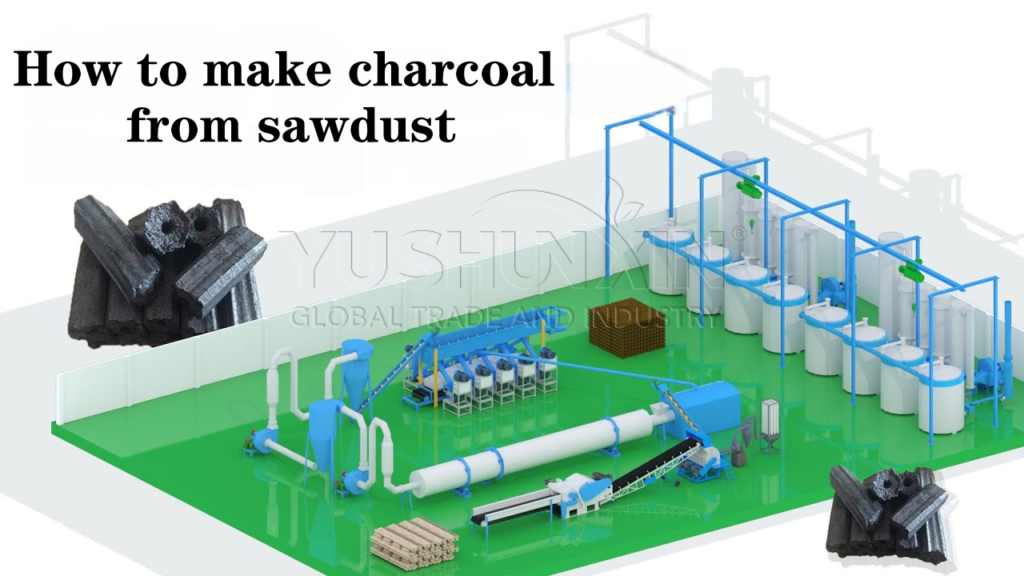
Raw Material Handling and Sizing
Start with charcoal lumps or charcoal fines delivered into a storage area and fed into a hopper. A hammer mill or crusher reduces lumps into powder, followed by a vibrating screen to control particle size (commonly fine powder for shisha briquettes and slightly coarser for some BBQ products). Stable particle size improves compaction and reduces cracks. If incoming charcoal is damp, add a dryer (rotary drum or belt dryer) to bring moisture down to a workable level before mixing.
Binder System and Mixing Section
Most charcoal briquettes need a binder such as starch, molasses, or other suitable agents depending on the target market. A binder preparation tank (often heated for starch) helps dissolve and stabilize the binder. The plant then uses a continuous mixer—double-shaft paddle or ribbon type—paired with water/binder dosing pumps. For 1 ton/hour, accurate dosing is critical: too little binder lowers strength and increases breakage; too much binder increases smoke, cost, and drying load. The goal is a uniform, slightly plastic mix that forms cleanly without sticking.
Briquette Forming and Output Control
The forming machine is the core investment. A roller press is common for pillow or oval briquettes, while a screw extruder is chosen for hexagonal briquettes with a center hole. At 1 ton/hour, ensure the press is matched with a forced feeder and a stable drive system to maintain constant pressure. Install a discharge conveyor to move green (fresh) briquettes gently, avoiding drops that create edge chipping and excess fines.
Drying, Cooling, and Packaging
Drying often becomes the limiting step at this scale. A continuous belt dryer or tunnel dryer sized for 1 ton/hour output is usually required, with heat supplied by biomass/charcoal, gas, or electric systems depending on local cost and regulations. After drying, briquettes should pass through a cooling conveyor or cooling room before bagging. Packaging typically includes a weighing scale, bagging machine, and sealer, with options for 1–5 kg retail bags or 10–25 kg bulk sacks.
Utilities, Layout, and Quality Checks
Plan for reliable power, dust collection (cyclone + bag filter), and safe material flow with minimal manual re-handling. Keep the crusher and mixing area separated from packaging to reduce dust contamination. Basic quality control—moisture checks, drop tests, density checks, and burn trials—helps you tune binder ratio, moisture, and press settings until the line consistently meets market expectations. Visiting: https://www.char-molder.com/product/charcoal-briquette-machine-price/
Leave a Reply