Commissioning risk falls when an EPC contractor turns the biochar production design into a staged test plan before construction begins. The biochar production solution technical route connects feedstock preparation, continuous carbonization, syngas recovery, char cooling and product screening in one technical sequence. commissioning then becomes a controlled handover process with defined tests at each boundary. The contractor, equipment supplier and plant owner share one commissioning schedule, one data sheet and one list of acceptance conditions. That preparation reveals utility gaps and control conflicts while the project team can still correct them without delaying the production start.
Which design decisions reduce commissioning risk in a biochar production project?
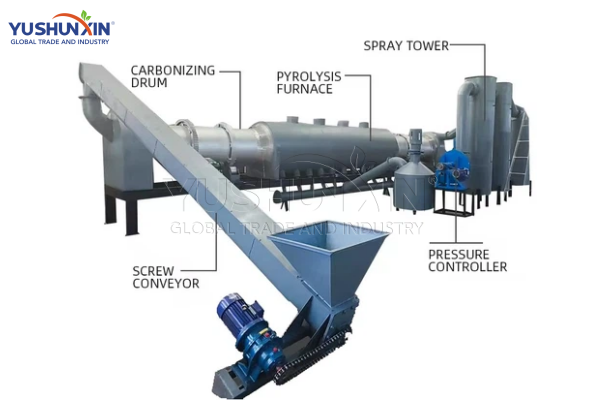
The technical route starts with a measured range for moisture, particle size and ash content in the biomass feedstock. A EPC commissioning plan for biochar production then fixes the required drying duty, furnace residence time, syngas pressure and char cooling load before suppliers issue final drawings. The design also defines bypasses, isolation points and safe shutdown states for the feeding machinery, reactor and gas handling system. EPC teams review the electrical load list with the actual motors and controls rather than with early estimates. A complete sequence diagram gives every subcontractor the same boundary conditions and prevents a late discovery that one conveyor or blower lacks the capacity required by the continuous carbonization line.
How does an EPC team organize the commissioning sequence?
The sequence starts with utility checks, cold rotation and instrument calibration, then advances to inert gas tests and heat-up with an inert feed. A commissioning risk in a biochar plant assigns a responsible engineer, test record and acceptance limit to every step. The continuous carbonization furnace operating principle chapter helps the team align burner control, screw speed and discharge temperature with the furnace design. Operators demonstrate normal start, controlled stop and emergency shutdown before the plant receives fresh biomass. Each subsystem then runs alone and later joins the integrated production line. This staged method exposes control faults, seal leaks and blocked transfer points before a full heat run puts the carbonization equipment under production load.
Which acceptance tests prove that the plant meets its performance targets?
The performance test measures feed rate, moisture removal, carbon yield, syngas quality, char temperature and dust release across a sustained run. The team samples product at fixed intervals and sends composite samples to an independent laboratory. Acceptance criteria also cover energy consumption, emission readings and the response time of safety interlocks. The contractor records every deviation and states the corrective action before the owner signs the handover certificate. A stable run of sufficient duration matters more than a short peak output, because the plant must prove that the feeding system, furnace, discharge machinery and screening equipment work as one production unit with predictable operating cost.
How does the project team control the remaining risk after handover?
The risk register continues after handover with actions for spare parts, operator training, performance monitoring and warranty response. Critical items include thermocouples, rotary valves, drive motors, filter elements and control modules for the syngas system. The owner keeps a commissioning log that links each abnormal event to the equipment tag and the responsible party. Monthly reviews compare actual output and downtime with the acceptance baseline. EPC contractors also provide a clear escalation route for process faults that appear only after the plant processes different biomass. That support structure protects the investment while the operating team builds confidence with the continuous carbonization production line.
Conclusion for EPC contractors and biochar project owners
A biochar project starts reliably when the technical route, commissioning plan and acceptance test share one set of process values. The EPC contractor coordinates the dryer, feeder, furnace, syngas treatment system, discharge machinery and screening equipment as an integrated production line. An carbonization project engineering support that reviews the control philosophy and test records before construction reduces the chance of a late redesign. The owner also needs a documented spare-parts plan and a trained shift team before the first sustained run. The referenced continuous carbonization design is available at https://www.ysxcharpro.com/how-does-the-continuous-carbonization-furnaces-work/ for the next technical review.